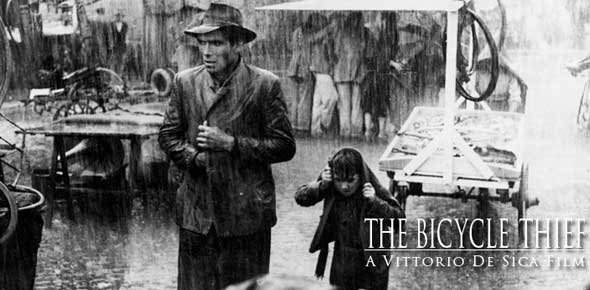
Ladri di biciclette (Bicycle Thief) - Vittorio De Sica
 |
| https://www.proprofs.com/quiz-school/topic_images/p19c7d0hjr1jacnc91a96mr953.jpg |
INTRODUCTION
This review is written in an attempt to determine the elements of Italian Neorealism found in the film Ladri di biciclette directed by Vittorio De Sica in 1948. The theory to use is semantic and syntactic approaches to genres.
THEORY DISCUSSION
According to cineCollage (n. d.), Italian Neorealism is a style of film characterized by stories set among the poor and lower working class, filmed on location, and frequently using non-professional actors. The films mostly reflect the conditions and everyday life of people in Italy after World War II (WWII) economically and mentally such as poverty and desperation.
Italian Neorealism generally abolishes planned plots, the scripts are improvised on site. Due to limited budget, they don't film it in studios or hire professional actors. Instead, filmmaker uses real local people and real locations to establish the contemporary social reality in the film. There are also mixture of professional actors and social actors in the film. Humanistic point-of-view is also included in the film.
SYNOPSIS
Antonio Ricci is an unemployed man in the depressed post-World War II economy of Italy who is desperate for work to support his family. He gets a job of hanging up posters with the condition that he has a bicycle for work. Sadly, his bicycle is stolen by thief when he's hanging up posters.
The police does not take his report seriously, so Antonio has to look for the bicycle with his friends but left with disappointment. When he manages to locate the thief, he fails to accuse the thief because he did not catch the thief red-handed.
Antonio ends up stealing a bicycle outside an apartment but caught by a crowd of men who humiliate him in front of his son. He should be sent to police station but the owner of the bicycle declines to press charges. At the end, Antonio and his son walk away with sadness while holding hands.
ANALYSIS
In the film, the social status and poverty of Antonio portrayed the poor economical condition of Italy during post-World War II. The struggles of securing the job and looking for the lost bicycle showed how desperate he was, it represented the desperation of the overall society in Italy during that time.
Most of the scenes in the film were filmed outdoor or exteriors as the filmmaker used real location of the places to film rather than filming in studios. For example: the streets of Italy when Antonio searched for his lost bicycle with his friends, the post-WWII Italy buildings shown when Antonio got chased while trying to runaway with stolen bicycle, and the alley where Antonio hung up posters before losing his bicycle.
The actors in the film were mostly social actors or local people as they're non-professional actors. The only professional actor in the film was the officer who gave Antonio the job as people who hung up posters.
One noticeable element in the film was the background musics which were so emotional especially during scenes where Antonio was in great dilemma. It aided the creation of sad atmosphere during some of the humanistic point-of-view scenes in the film as well.
The actors in the film were mostly social actors or local people as they're non-professional actors. The only professional actor in the film was the officer who gave Antonio the job as people who hung up posters.
One noticeable element in the film was the background musics which were so emotional especially during scenes where Antonio was in great dilemma. It aided the creation of sad atmosphere during some of the humanistic point-of-view scenes in the film as well.
CONCLUSION
In conclusion, Italian Neorealism is a film trend that establishes the contemporary social reality of Italy after WWII with limited budget. Hence, social actors and real locations are chosen by filmmakers to portray the condition of the people of Italy. Although the ending didn't go well but it reflects just what the reality of life is.
REFERENCE


Comments
Post a Comment